






Cotton, silicone, leather: Which oven mitt should you choose to avoid getting burned?
When it comes to taking a baking dish out of the oven or grabbing the handles of a scorching hot pot, oven mitts (or gloves) protect our fingers. Whether made of fabric, silicone, or leather, this protective accessory comes in many forms, all with a single purpose: to prevent the kitchen from turning into a trial by fire.

There’s this reflex that’s become almost automatic: opening the oven door, grabbing the first dish towel lying around, and trying to pick up the scorching-hot dish. Bad idea. The fabric slips, doesn’t cover all your fingers, the heat seeps through, and you hastily set the dish down on the countertop… in the best-case scenario. The oven mitt was created precisely to prevent these everyday accidents, which can be dangerous. Its name comes from the Latin *manica*, which referred to a sleeve or arm protection. While its modern form didn’t appear until the late 19th century, the idea of protecting hands from heat is much older, thanks to the “iron hand”—a sort of metal handle designed to grip cauldrons—or wooden and leather guards used to handle irons.
To Each Its Own Material
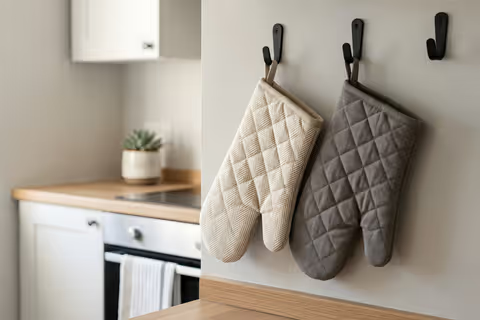
While all oven mitts serve the same purpose, they are not all created equal. The choice of material determines the level of protection, comfort, and durability. Cotton models, the most common, consist of several layers of fabric to slow the transfer of heat. Inexpensive and comfortable to hold, they do have their limitations: if you hold a steaming dish between your fingers for too long, the heat eventually passes through the oven mitt and reaches your hands.
Fortunately, some models incorporate a layer of polyester that improves heat resistance. Other fibers, such as linen or wool, also provide insulation. Over the past few decades, silicone has become a staple thanks to its excellent resistance to high temperatures—up to 300 °C depending on the model. It doesn’t melt, doesn’t catch fire, is easy to clean, and remains flexible. The only downside is that it can sometimes make for a less precise grip, especially when handling small containers.
Although it requires more maintenance, leather appeals for its sturdiness, durability, and good heat resistance. However, it’s best to avoid synthetic leather, which generally performs less well. Finally, aramid is the preferred choice for daring cooks. Highly resistant to tears, cuts, and impacts, it withstands temperatures ranging from 200 to 400 °C depending on the fibers used. In fact, this is the same material found in firefighters’ protective gear.
Are all your fingers protected?
Yes, but only if you choose the right style. The mitt covers the hand from the fingertips to the wrist, allowing you to safely handle large dishes straight out of the oven. Some prefer the five-finger glove, which offers greater precision and freedom of movement. The square oven mitt, often paired with mittens, slips easily into a drawer or hangs next to the dish towels, but it requires more caution since the hand remains partially exposed.
Finally, let’s not overlook oven tongs. While they’re certainly compact, they only protect the tips of your fingers. They’re best suited for gripping the handles of a dish or a rack. Ultimately, no matter which style you choose, the key in the kitchen is being able to play with fire… without ever getting burned.

2. The magnetic option. 100% cotton oven mitt with built-in magnet. Le Creuset, €35.
3. The all-terrain option. Pair of aramid and leather oven mitts. Petromax, €19.99.
4. The durable option. Silicone kitchen tongs. Lékué, €17.75.
5. The natural choice. Raw linen oven mitt made in France. La Grande Épicerie de Paris, €16.50.
6. The vintage choice. Pair of leather oven mitts. Skottsberg, €19.99.
7. The Inseparable Pair. Set of a checkered oven mitt and kitchen glove, 100% cotton exterior and polyester filling. La Carafe, €14.90.